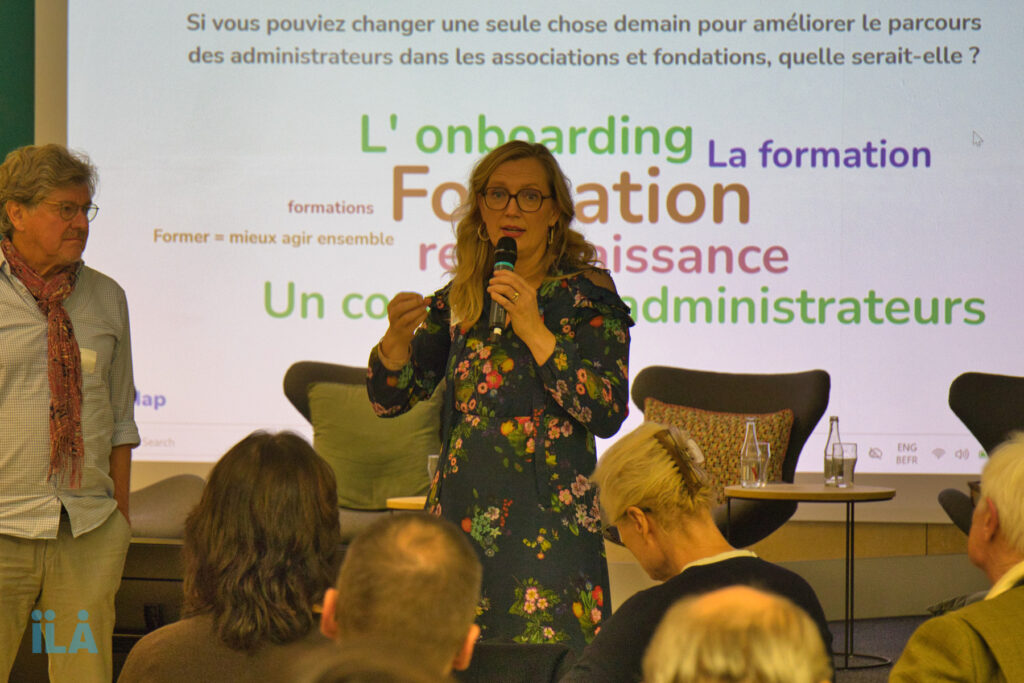
“Be ambitious. Secure the funding.” “Protect our independence and our values.” Most fundraisers and leaders receive both messages, often from the same board, sometimes in the same meeting. On 25 September, at the PPE-Myriad USA conference in Paris, I invited participants to look at what happens when these two expectations pull in different directions, and how institutions can meet both without losing themselves.
Three questions that are not the same
When a sensitive gift arrives, discussions often mix three very different questions:
1. Legality: what are we permitted or required to do?
2. Reputation: how might others interpret our decision?
3. Ethics: what should we do?
A decision can pass the first test and fail the other two. Keeping these questions apart is the first step towards a clear decision. Three lenses help: the consequences (who benefits, and who may be harmed?), the principles and duties (what commitments and boundaries apply?), and the relationships and power (who has influence, and who can say no?).
What institutions learned the hard way
The cultural and academic sectors offer instructive examples. In 2019, the Metropolitan Museum of Art suspended gifts from Sackler family members then associated with Purdue Pharma and the opioid crisis. Two years later, the family name was removed from seven exhibition spaces. The decision came under intense public pressure, with little consistency in communication.
The same year, the Whitney Museum faced protests about its vice-chair, Warren Kanders, whose company produced tear gas. Staff raised concerns, artists asked to withdraw their work, and he resigned in July 2019. The case raises a difficult question: who can assess a relationship when the donor also holds governing power?
Earlier still, the London School of Economics accepted a pledge from a foundation chaired by Saif al-Islam Gaddafi. The director resigned in 2011, and the independent Woolf Inquiry identified shortcomings in due diligence, communication and governance.
None of these institutions acted illegally at the outset. What they lacked was shared language, clear decision routes and a framework agreed before the pressure arrived.
The language of pressure
Ethical failures rarely start with bad intentions. They start with sentences we all know: “We cannot afford to lose this gift.” “The event is next week.” “The chair has already agreed.” “Other institutions accept this funding.”
Under this pressure, there is no time to reflect, decisions are taken by default, responsibility is diluted and teams are left exposed. Leadership approves the decision, but staff, artists, researchers and audiences carry its consequences. The institution carries the reputation, long after everyone involved has moved on.
Influence does not even need a contract. Access, expectations and gratitude can quietly shape priorities. A generous gift that fits the mission but not current priorities, covers launch costs but not running costs, and draws staff away from existing work deserves as much scrutiny as a controversial donor.
From principles to practice
Preparedness rests on a few concrete elements:
– shared principles for donor relationships: mission and independence guide funding decisions, donor expectations are explicit, and sensitive decisions have a written rationale;
– clear escalation paths: fundraising identifies, documents and recommends; an authorised decision-maker approves, sets conditions, defers or declines; a named relationship owner implements and monitors;
– a culture where escalation is encouraged, not penalised, so that raising a concern never depends on courage alone;
– decision memory: what was decided, why, under which conditions, and when it will be reviewed.
As I told participants: if you do not document, you repeat. This is not bureaucracy. It is institutional memory!
Responsible boldness
Ethics in fundraising is not about saying no more often. It is about choosing deliberately between four options: pursue an opportunity worth exploring, pause to resolve a specific uncertainty, negotiate conditions that protect the mission, or decline when the concern cannot be addressed.
Ethics is readiness. It allows organisations to be ambitious precisely because they know where their boundaries are. These questions deserve to be discussed openly between peers, across sectors and countries. Every institution has its own dilemmas, and we all gain from sharing how we handle them. To start, choose one boundary to clarify, one decision route to confirm and one conversation to open, and decide with whom and by when.