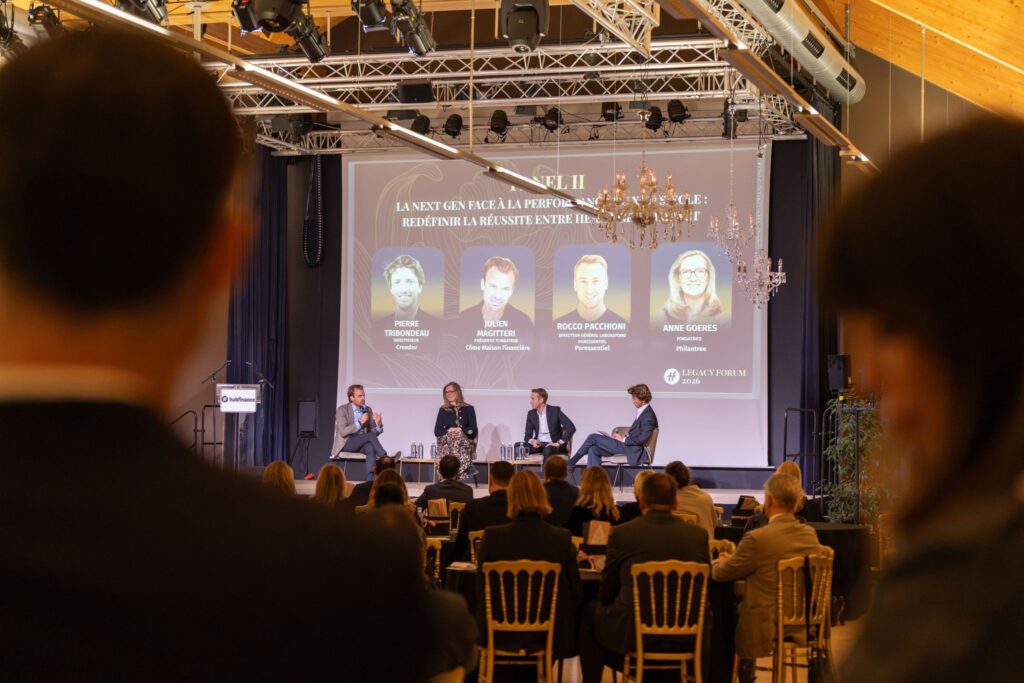
Families often start their philanthropic journey with the wrong question: which vehicle? A foundation, a donor-advised fund, a sheltered foundation, direct giving? The right question comes first: what for, and who decides? On 19 November, I joined the Next Gen panel at the Legacy Forum, alongside a family investor, a second-generation entrepreneur and a family office founder. Our conversation kept returning to that question.
Philanthropy, business and impact investing: one relay race
Are philanthropy, corporate engagement and impact investing competitors? I see them as complementary, like three runners in the same relay race. Philanthropy takes the risks the market will not take: it funds what does not yet have an economic model. Impact investing changes scale once that model exists. And the company anchors engagement in everyday life.
One example from my practice illustrates this last point. A company used to give on an ad hoc basis, following requests as they came. Good causes, but no common thread, and employees barely knew about it. The leadership then decided to involve employees. Together, they defined the framework: which causes, which criteria, which budget, how projects are chosen. Then the employees selected the projects themselves.
Three things changed: real pride among employees, who now talk about “their” projects; genuine commitment from leaders, who accepted to share the decision; and shared values that are lived rather than displayed on a wall. This is exactly the shift the Next Gen brings to families: from giving alone to deciding together.
What the Next Gen expects
The younger generation does not keep its money in separate boxes. For them, philanthropy is part of the wealth strategy, not a side activity. Research supports this. In Generation Impact (Goldseker and Moody, 2017), based on interviews with more than 300 young major donors in the United States, the word that came up most often to describe what sets them apart from their parents was “impact”. They want relationships, not transactions.
This also changes the way impact is measured. I suggest distinguishing three levels: what was done, what changed for people, and what lasts. On the last level, a funder contributes but never claims the result alone. Measurement should also be proportionate: a three-person association cannot report like a multinational, and if funders want measurement, they should fund it. The best indicator is the one the organisation already uses to steer its own work. Trust, too, produces impact.
From intuitive generosity to structured engagement
Giving the Next Gen real means to decide rests on three steps.
1. The why. Write down the family’s values and causes in a family philanthropy charter. It extends the family manifesto that many entrepreneurial families already use.
2. The vehicle, in proportion to the ambition. In Luxembourg, a family can give directly, create a sheltered foundation, for example at the Fondation de Luxembourg, which hosted 126 of them at the end of 2025, or set up its own foundation for larger ambitions. A sheltered foundation allows a quick start with professional management. An independent foundation brings more autonomy but requires more resources.
3. The Next Gen’s place in governance. A real seat with voting rights on the board, not an observer’s folding chair. A Next Gen committee with its own budget: young family members set their criteria, meet project leaders, decide and report back to the family council a year later. And the field before the cheque: visits, volunteering, encounters.
The first door into family governance
Philanthropy is often the Next Gen’s first door into family governance. It is where they learn to decide together, to make trade-offs and to be accountable, long before they do so for the business or the family wealth. Raising awareness shows them the table. Entrusting them with a budget and a voice gives them a chair.
Two lessons from experience. What not to repeat: giving in silence, without talking about it in the family, because generosity is only passed on if it is told. What to repeat: loyalty to a cause over time. And to an adviser whose 25-year-old client wants to give meaning to their wealth, I would say: do not start with the vehicle. Ask what moves them, take them into the field, and propose a first twelve-month trial commitment.
These questions are at the heart of my work with families, family offices and their advisers in Luxembourg. They deserve to be explored together, between generations and between peers.