Behind every legal reform lies a more discreet reality: that of organisations that have to understand, adapt, explain and implement, often with limited resources, in a daily reality already strongly mobilised by their mission.
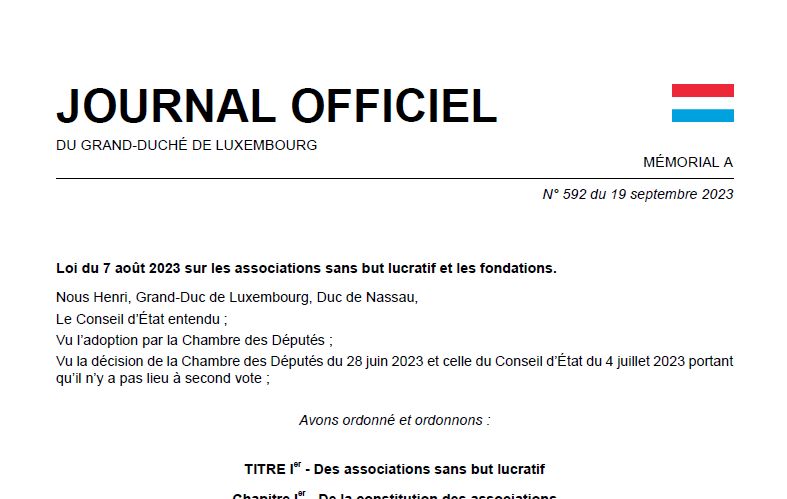
The law of 7 August 2023 marked an important step in Luxembourg. It brought greater clarity, introduced a principle of proportionality according to the size of asbls and foundations, recognised certain economic realities more explicitly and encouraged more coherent accounting structures. For many organisations, these developments are real. They help to better define responsibilities, clarify certain obligations and move the sector towards greater readability. And this is a very positive development. But a reform is not measured only by its legal text. It is also measured by the way it is understood, appropriated and experienced by those who have to implement it.
The moment when the framework meets the reality on the ground
In discussions with organisations, one reality comes up again and again: the need for clarity does not disappear with the reform. It shifts, because the questions become more concrete. What needs to be formalised? How far should structuring go? How can obligations be applied without unnecessarily burdening the organisation’s functioning? How should one distinguish between what falls under the responsibility of the board of directors, the operational team, the general assembly or the management? How can decisions be secured without losing the agility that is also one of the strengths of the non-profit sector? Who takes responsibility for this, and within what timeframe? How should one go about it?
These questions are not secondary. They go to the very heart of how organisations function. Behind legal obligations lie very practical issues: the distribution of roles, the flow of information, the ability to make decisions, the prevention of conflicts of interest, the management of responsibilities and the coherence between mission, resources and governance.
This is probably where many organisations feel the reform most strongly. Not as an abstract principle, but as an invitation to look at their own functioning with greater lucidity.
What has moved forward, and what still needs to be clarified
The principle of proportionality introduced by the reform is an important step forward. It recognises that not all organisations have the same resources, the same level of complexity or the same administrative capacity. A small asbl run by volunteers does not operate in the same way as a structured foundation with paid staff, significant funding and multiple partnerships. This recognition is essential. It helps to avoid a one-size-fits-all approach that could weaken precisely those organisations that are smaller or most deeply engaged on the ground.
However, several issues remain sensitive. Are three size categories sufficient, or would a more refined approach better reflect the reality of the sector, perhaps by adding one or two additional levels? Administrative burden also remains a real concern for many organisations. The question of family and patrimonial foundations also deserves careful consideration, within a framework that clearly distinguishes public benefit, transmission, philanthropic engagement and responsibility. The possibility of compensating board members for their commitment, expertise and the responsibilities they carry also raises important questions.
These debates must be approached seriously. They are not about turning non-profit organisations into conventional businesses, but rather about recognising that governance requires time, skills, availability and, at times, a degree of personal risk. In a sector where voluntary commitment remains fundamental, this reflection is delicate. But it is necessary.
The adjustments needed to support the sector
Recognising the progress made by the reform does not mean considering that the legislator’s work is complete. On the contrary, it is often when a framework begins to be applied that the need for adjustment becomes most visible.
Several questions now deserve further consideration. The first concerns proportionality. The principle is relevant, but its application could still be made more precise. Are three size categories enough to reflect the real diversity of the sector? Between a small local asbl, a medium-sized organisation with employees and a well-endowed foundation, the administrative, financial and human realities can vary considerably.
The second question concerns administrative burden. For some organisations, particularly the smallest or those relying heavily on volunteers, the new obligations remain difficult to absorb. The risk is not only that of an additional constraint. It is also the risk of discouragement, of professionalisation being experienced as something imposed, or of formal compliance without any real appropriation of its meaning.
There is also a need for support. A reform, even a necessary one, only produces its full effects if the actors concerned have the tools to understand it and put it into practice. Templates, guides, training, peer exchange spaces and targeted support are essential to ensure that the legal framework does not remain theoretical or become an isolated burden.
Finally, some issues remain insufficiently addressed or call for further clarification: the place of family and patrimonial foundations, the recognition of the commitment and responsibilities of board members, the articulation between volunteering, expertise and compensation, and the possible creation of a reference point for the non-profit sector in Luxembourg.
These points do not call into question the value of the reform. On the contrary, they show that a legal framework must be able to evolve in contact with the reality on the ground. A useful law is not only a well-written law. It is a law that can be understood, applied, adjusted and supported over time.
Structuring without overburdening
The real challenge today is not only to comply with a legal framework. It is to turn that framework into something useful for organisations.
Good governance does not consist of producing more documents, procedures or formal approvals. It consists of creating the conditions for clearer, more responsible and more sustainable functioning. It helps establish who decides, according to which criteria, with what information, within which framework and with what limits.
This structuring must not weaken the original energy of organisations. On the contrary, it should protect it, secure it and make it sustainable.
When roles are clarified, decisions become more fluid. When responsibilities are better distributed, tensions decrease. When the board of directors finds its rightful place, it can fully play its strategic role without replacing the operational team. When the framework is shared, everyone can act with greater confidence.
This is where I like to think that the reform can become a genuine opportunity. Not because it requires organisations to do more, but because it invites them to do better.
After the framework, appropriation
These questions are receiving growing attention in Luxembourg. They are being discussed in different professional, associative and institutional spaces, including through exchanges held within the NPO Working Group of ILA, which I co-chair.
This article does not constitute an official position of ILA. It offers a personal reading, shaped by exchanges with many organisations, by training sessions, workshops, field meetings and the very concrete questions that emerge through support and advisory work.
What emerges from these exchanges is a strong expectation: a framework that is understandable, proportionate, applicable and useful. Organisations are not asking for less responsibility. They are often asking for the means to exercise it properly.
In many respects, the reform therefore opens a new stage. After the time of the legal text comes the time of appropriation. After the framework comes practice. After compliance comes living governance.
The reform has established a necessary framework. The next step is to adjust it where practice reveals its limits, to support it where organisations lack resources, and to use it as a foundation for strengthening governance across the sector.
The real issue is therefore not only legal. It is practical, strategic and collective. It is about enabling asbls and foundations to exercise their responsibilities with clarity, without losing their agility, commitment and capacity to act. Only then will the reform be able to fully deliver on its promise: not to burden the sector further, but to give it the means to structure itself, strengthen its safeguards and endure over time.